
 Standard Bulbs
 Golf Ball Bulbs
 Candle Bulbs
 Globe Bulbs
 Top Mirror Bulbs
 Carbon Filament Bulbs
 Reflector Bulbs
 Superlux Bulbs
 Colored Bulbs
 Special Use Bulbs
 Tube Lamps
 Flame
 Bundles
 ECO Classic Bulbs
 Top Mirror Bulbs
 R7s Tube Bulbs
 E14 Halolux Bulbs
 E27 Halolux Bulbs
 B15d Bayonet Cap Bulbs
 E14 & E27 PAR Spots
 GU10 Spots
 GU4, GU5.3 & AR111 Spots
 G4 & GY6,3 Capsule Bulbs
 G9 Capsule Bulbs
 SOX & CDM Low-Pressure & Discharge
 HPL-N / HQL Discharge Bulbs
 Flame
 Bundles
 Quadro lamps
 Buislampen
 Speciale toepassing
 T8 LED TL Buizen
 T5 LED TL Buizen
 LED PL C Lampen
 LED PL S Lampen
 LED PL L lampen
 Standard Bulbs
 Golf Ball Bulbs
 Candle Bulbs
 Twisted Candle Bulbs
 Candle Bulbs with Tip
 Globe Bulbs
 Top Mirror Bulbs
 Edison Bulbs
 Reflector Bulbs
 Design Bulbs
 Colored Bulbs
 Tube Bulbs
 Giant Bulbs
 G9 Capsule Bulbs
 3 Way Dimmer LED Bulbs
 Low voltage
 Bundels
 Standard Bulbs
 Golf Ball Bulbs
 Candle Bulbs
 Reflector Bulbs
 Colored Bulbs
 Tubular Bulbs
 T8 Tube Lights
 Philinea Lights
 GU4 & GU5,3 Spots
 GU10 Spots
 G4, G9 & GY6,35 Capsule Bulbs
 Carbon Filament Bulbs
 Sensor Bulbs
 Deco Bulbs
 Low voltage
 Flame
 Bundles
 Standard Bulbs
 Candle Bulbs
 Golf Ball Bulbs
 Spots
 Globe Bulbs
 Edison Bulbs
 Design Bulbs
 Safety
 Accessories
 T5 Tube Lights
 T8 (TL-D) Lights
 Mini Tube Lights
 LED Tubes
 Exit Lights
 Round Lights
 Colored Tubes
 Bug Zapper Lights
 Starters
 T6 Fluorescent Tubes
 T4 Fluorescent Tubes
 T12 Fluorescent Tubes
 Blacklights
 TL Fixtures
 T2 Lampen
 T9 lampen
 PL-S 2-pin & 4-pin
 PL-C 2-pin & 4-pin
 PL-H 4-pin
 PL-L 4-pin
 PL-T 2-pin & 4-pin
 Biax 2D 2-pin & 4-pin
 Dulux F 4-pin
 Dulux D/E 4-pins
 Dulux D 2-pins
 Dulux T/E 4-pins
 Dulux L 4-pins
 Dulux S 2-pins
 Dulux T 2-pins
 Dulux S/E 4-pins
 PL-Q 2-pins & 4-pins
 Dulux CFL Square
 CDM bulbs
 HPL N / HQL bulbs
 SOX bulbs
 Ceiling Cups
 Dimmers
 Sockets
 Socket Adaptors
 Pendants
 Cords & Cables
 Halogen Drivers
 Garden Lights
 Miscellaneous
 Batteries
 Lampholders
 Top 25
 Top 10 Gloeilampen
 Top 10 Halogeenlampen
 Top 10 LED Filament
 Top 10 TL Lampen
 Top 10 PL Lampen
 Top 10 Bundels
 Lighto
 Philips
 Osram
 Calex
 Megaman
 SPL
 Lightbulbcheap.com
 Segula
 Bailey
 Sale
 Op = Op
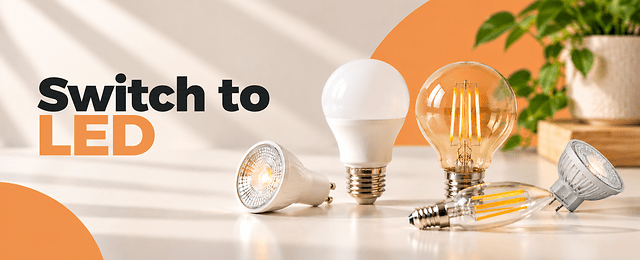
Why switch to LED lighting?
Looking to replace your old lighting? Switching to LED is a sensible choice. LED bulbs use considerably less energy than traditional incandescent and halogen bulbs and also have a much longer lifespan. This means you need to replace your bulbs less often while reducing the energy consumption of your lighting.
You do not have to compromise on atmosphere either. LED lighting is now available in virtually all common shapes, fittings and light colours. From a warm LED filament bulb for the living room to a bright LED spotlight for the kitchen or workspace.
Which LED bulb replaces my old bulb?
When replacing an incandescent or halogen bulb, it is important not to look at wattage alone. With LED lighting, wattage mainly indicates how much energy the bulb uses. To determine how much light a bulb produces, look at the number of lumens.
Would you like to keep roughly the same amount of light? Compare the lumen output of your current bulb with that of the new LED bulb. Also check that the fitting is the same. Common fittings such as E27, E14, GU10, G9 and G4 are all available as LED versions.
- Fitting: check that the new bulb has the same connection.
- Lumens: indicate how much light the bulb produces.
- Kelvin: indicates the colour and warmth of the light.
- Dimmability: check that both the LED bulb and the dimmer are compatible.
- Dimensions: check that the LED bulb fits in the existing light fitting.
Choose the right light colour
One of the advantages of LED lighting is the wide range of light colours available. Colour temperature is expressed in Kelvin (K). The lower the Kelvin value, the warmer and more atmospheric the light appears.
- 1800K - 2200K: very warm and atmospheric light.
- 2700K: warm white light, similar to a traditional incandescent bulb.
- 3000K: warm white, but slightly brighter and more neutral.
- 4000K: neutral white light for functional spaces.
- 6000K - 6500K: bright daylight white.
For living rooms and bedrooms, warm light of around 2200K to 2700K is often preferred. In areas where good visibility is important, such as an office, garage or workspace, a higher colour temperature may be more suitable.
From a traditional incandescent bulb to LED filament
Would you like to save energy while keeping the appearance of a traditional incandescent bulb? LED filament bulbs are a good solution. The visible filaments give the bulb the familiar appearance of a traditional light bulb while using energy-efficient LED technology.
LED filament bulbs are available in different shapes, glass finishes and light colours. This makes them particularly suitable for open fittings and other places where the light source is clearly visible.
What to consider when dimming LED bulbs
Do you currently use a dimmable incandescent or halogen bulb? Before switching, check that the new LED bulb is dimmable. Not every LED bulb can be dimmed.
Older dimmers are also not always suitable for the lower power requirements of LED lighting. This can cause a bulb to flicker, buzz or fail to dim properly. In that case, you may need a dimmer designed specifically for LED lighting.
Switch to LED step by step
You do not need to replace all the lighting in your home at once. Start, for example, with bulbs that are switched on for many hours each day. This could include lighting in the living room, kitchen, hallway or home office. These are generally the areas where lower energy consumption provides the greatest benefit.
For each bulb, check the fitting, desired light output, light colour and whether dimming is required. This allows you to replace your existing lighting step by step without significantly changing the atmosphere or amount of light in your home.
Ready to switch to LED?
There is now a suitable LED alternative for almost every traditional light source. Whether you want to replace a standard bulb, spotlight, candle bulb, golf ball bulb or small capsule bulb, pay particular attention to the correct fitting, light output and light colour.
Explore our range and easily find an LED bulb that suits your existing lighting.